 Sales
SalesBuilding a Reusable ESG Response Library for Your Sales Team
Learn how to build a centralized ESG response library that helps sales teams answer vendor questionnaires faster and win more enterprise deals.
11 min read

27 articles
SalesLearn how to build a centralized ESG response library that helps sales teams answer vendor questionnaires faster and win more enterprise deals.
 Sales
SalesESG questionnaires are moving from investor-facing reports into software vendor assessments. Learn why procurement teams now ask about carbon emissions, data center energy, diversity data, and governance — and what a credible vendor response looks like.
 Sales
SalesA financial analysis of when enterprise SaaS companies should subsidize implementation costs to accelerate deal close or expansion, how to structure the subsidy, and the risks of getting the math wrong.
 Security & Compliance
How SaaS vendors can transform data-deletion capability from a compliance checkbox into an active late-stage sales accelerator that resolves DPA redlines and closes enterprise deals faster.
 RevOps
How to design a deal desk function that accelerates non-standard deal closings — covering approval workflows, discount governance, custom contract terms, and the operational cadence that prevents revenue leakage.
 Vertical SaaS
A detailed breakdown of how large enterprises evaluate and buy HR software — from initial problem recognition through multi-stakeholder approval, IT security review, and contract negotiation.
 Sales
SalesMid-market deals stall because both parties let them. Mutual action plans create shared accountability for deal progression — making the prospect a co-owner of the close timeline rather than a passive evaluator.
 Security & Compliance
A tactical playbook for SaaS AEs and founders who discover their product is already running inside a prospect's org without IT approval—and how to turn that into a signed enterprise deal.
 Security & Compliance
Tactical guidance on structuring sub-processor disclosures that satisfy GDPR Article 28 and DPA requirements without triggering enterprise procurement paralysis.
 International Growth
Data residency is typically treated as a compliance burden. Forward-thinking SaaS companies are turning EU data residency infrastructure into a competitive differentiator that accelerates enterprise deals, displaces incumbents, and commands premium pricing.
 Security & Compliance
SOC 2 Type II certification compresses enterprise security review cycles by 4–8 weeks, unlocking faster revenue from security-sensitive buyers. This guide covers the cost, ROI calculation, and which buyer segments require vs. prefer it.
 Security & Compliance
A well-built trust center page replaces weeks of security questionnaire back-and-forth with self-serve documentation access. This guide covers the required components, the deal-closing role of trust centers, and the platforms that build them.
 Security & Compliance
Enterprise procurement teams send SIG Lite, SIG Core, and CAIQ questionnaires to every vendor they evaluate. Building a response library with pre-approved answers and evidence artifacts compresses turnaround from weeks to days and directly accelerates deal velocity.
 AI-Native SaaS
How to handle Bring Your Own Key (BYOK) and customer-managed encryption objections in enterprise AI-native SaaS sales. Covers when BYOK is a genuine requirement, the engineering cost, and the enterprise segments where it is non-negotiable.
 AI-Native SaaS
How to handle enterprise buyer concerns about data privacy, training data use, and data residency in AI-native SaaS. Covers the five core data-handling objections and the contract language plus architectural evidence that resolves each one.
 AI-Native SaaS
The full AI-native SaaS enterprise buyer journey from problem awareness to production deployment — and where deals stall. Maps 7 stages, average time in each, key stakeholders, and the vendor actions that accelerate each transition.
 AI-Native SaaS
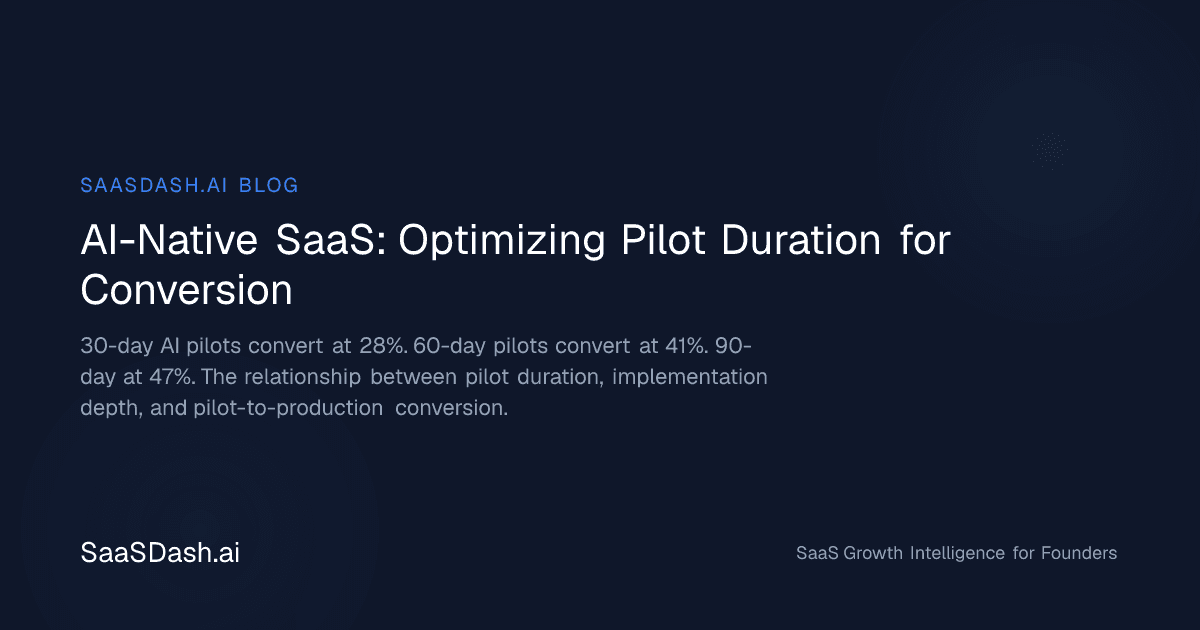
How to design AI-native SaaS pilots with the right duration to generate evidence without stalling deals. Covers the data science behind pilot duration, short vs. extended pilot trade-offs, extension risk, and the metrics that signal whether to accelerate or extend.
 AI-Native SaaS
How AI-native SaaS companies convert pilots and POCs into production contracts at enterprise accounts. Covers success criteria design, champion cultivation, security review sequencing, and the conversion signals that predict close.
 AI-Native SaaS
How to design POC success criteria that accelerate AI-native SaaS sales cycles and prevent scope creep. Covers mutual success plan structure, quantitative and qualitative criteria, time-boxing, stakeholder sign-off, and the post-POC debrief that converts to purchase.
 AI-Native SaaS
The complete playbook for handling procurement objections unique to AI-native SaaS — covering security, data handling, model governance, and vendor lock-in with the evidence packages that move enterprise deals forward.
 AI-Native SaaS
Analysis of the most common contract redlines in AI-native SaaS enterprise deals and how to respond to each. Covers the top 8 redline categories, their frequency, and the negotiating positions that preserve margin while closing deals.
 AI-Native SaaS
How AI-native SaaS companies respond to enterprise red-team and adversarial testing requirements during security review. Covers what security teams actually test, the documentation package that satisfies requirements, and how to build a security narrative that pre-empts delays.
 AI-Native SaaS
How AI-native SaaS companies compress enterprise security review timelines from 6 months to 6 weeks. Covers security self-assessment packages, pre-approved questionnaire responses, model governance documentation, and security champion cultivation inside the buyer.
 Pricing
How to sell outcome-based pricing to skeptical enterprise buyers who prefer predictable seat-based contracts. Covers buyer objections, floor and cap structures, pilot design, and the contract negotiation tactics that close outcome-based deals.
 Competitive Strategy
How to win deals against entrenched incumbents with larger sales teams, longer track records, and bigger brand budgets — the asymmetric attack strategies covering agility, vertical depth, champion-driven selling, proof-of-concept tactics, and making speed vs. maturity a feature not a liability.
 Vertical GTM
The bottoms-up sales playbook for developer tools: how individual developer adoption converts to paid team accounts, the metrics that signal expansion readiness, and the exact sequence for converting PLG momentum into enterprise revenue.
 Pricing
Enterprise SaaS deals involve negotiation by design — procurement teams expect it. The companies that protect margin while closing consistently have four things: a documented discount floor, a concession strategy, non-price negotiation levers, and a clear walk-away point.